
3 sessions each day
Museum admission not included
New dates added for November and December
November & December 2026 — 8 days, 3 sessions each day
JPY 15,000 per person · 60 minutes, in English · groups of up to 12 · solo travellers welcome
The design principle
Place, person, product
Authenticity is where they meet
Anyone can teach you to shape sugar and bean paste. Almost nowhere can you do it in a room like this one.
Place
Kujo-kan is a wooden building standing in the museum garden, and it is not open to the public. Visitors walk past it. For these sessions the doors open, and the workshop takes place inside — a setting that exists nowhere else.
Person
Your instructor is a wagashi professional who has spent years explaining Japanese culture to guests in English. The reasoning behind each shape reaches you directly, not through a translator.
Product
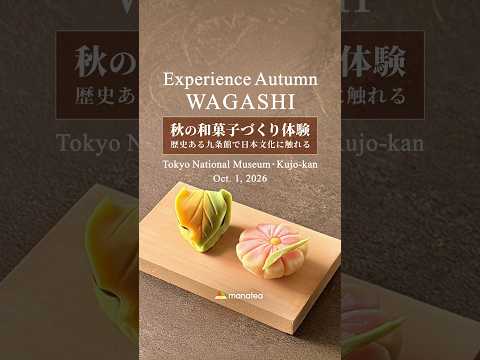
Nerikiri appeared in the Edo period, made for the tea ceremony. Chrysanthemum, plum, wisteria — the flowers are how the seasons are spoken about in Japanese art, and nerikiri is one of the traditional forms that language takes.
Context
Any one of these on its own is ordinary. Together — this room, this teacher, this confection, on one afternoon — they make an hour spent inside Japanese culture rather than looking at it from outside.


The building
Kujo-kan
For travelers who want to understand Japan, not just see it.
The room began inside the grounds of the Kyoto Imperial Palace, as part of the residence of the Kujo family. It was later rebuilt at the family's ducal villa in Akasaka, and in 1934 came here, to the museum garden, given by Kujo Michihide.
The Kujo were kuge — court nobility, not samurai. For some six centuries theirs was one of five families from which the emperor's regents were chosen, and the culture they kept was a Kyoto culture of ceremony, poetry and the turning of the seasons rather than one of the sword. That is the world this room was built for.
It is not, strictly, a teahouse but a shoin-style reception room: two rooms of ten tatami mats with a veranda on every side. Above the doors, a transom cut from a single plank of Chinese quince into openwork wisteria lozenges. On the alcove panels, a landscape with pavilions attributed to the Kano school.
- Origin
- Kujo residence, Kyoto Imperial Palace grounds
- Relocated
- Kujo ducal villa, Akasaka → museum garden, 1934
- Structure
- Single-storey timber, hipped tile roof, 15m × 10m
- Rooms
- Two rooms of ten tatami, encircling veranda
- Alcove
- Landscape with pavilions, attributed to the Kano school
- Transom
- Openwork wisteria lozenges, single Chinese quince plank
The museum garden is open throughout the year, but its historic teahouses are closed to visitors. Entry to Kujo-kan is by reserved booking.
Watch
See it in motion
Tap to watch on YouTube
The plan
Four things you will do
Two seasonal nerikiri confections, made by your own hands, then tasted with genmaicha — in the room where you made them. Sixty minutes, in English.

Meet your instructor
After a short welcome, your instructor introduces herself and gives a brief introduction to wagashi and its seasonal designs before the hands-on work begins.
Shape two nerikiri
Watching your instructor's hands and following her guidance, you shape two seasonal confections yourself. The difficult moments are the ones she steps in for — so the result is genuinely yours.
Taste with genmaicha
Both of your own nerikiri, tasted on the spot with genmaicha poured from the pot. This is the part the whole hour was built for.
Take one home
If you would like to take a piece with you, a box is provided so you can carry it home.
Please remove your rings
Because you will be shaping the dough with bare hands, we ask guests to remove rings before the session begins.
- Seating is on cushions at low tables on tatami. If sitting on the floor is difficult, a chair can be arranged — just ask when booking.
The instructor
Miyuki SuyariDirector of Wagashi Promotion Association Japan
Teaching wagashi in English since founding her school in 2014, and leading this programme for manatea.
Miyuki Suyari studied English literature at Tokyo University of Foreign Studies, then worked at the Japanese Consulate in Houston, in international sales and marketing at Sony, as an editor and producer for an online women's magazine, and as a translator for the AXN cable channel. Working between Japan and the world in language, she found herself drawn to wagashi — a way of speaking about the seasons that needs no translation.
She leads these sessions herself, in English. A Japanese-speaking assistant is also present, so Japanese guests can hear the reasoning behind each shape in their own language.
In 2014 she opened Simply Oishii Wagashi School in Meguro, Tokyo. Since then, more than ten thousand guests have visited. In July 2023 she founded the Wagashi Promotion Association Japan.
- Qualifications
- Certified Food Hygiene Supervisor (Tokyo) · Wagashi course, Tsuji Confectionery School · Certified nerikiri & anzaiku instructor
- Press
- YouTube · TBS · NHK Educational · Tokyo Weekender · Matcha.jp
Her school, Simply Oishii Wagashi School, is run by Wagashi Promotion Association Japan. In July 2023 she founded the association to share the craft more widely.

Who this is for
For guests who want to meet Japanese culture through place, material and their own hands
Whether you are in Japan for a week, you live here, or you are from here.
A cultural activity with depth
Every gesture, material and story is there to open up the quieter side of Japanese culture — not to fill an hour.
Small and attentive
Twelve guests at most, with an instructor and an assistant, so nobody works alone.
Inside the museum
The session sits in the garden of a national museum, in a building visitors walk past but do not enter — a few minutes from the galleries.
Location
Finding Kujo-kan
Kujo-kan stands in the museum garden, behind the main gallery building — a few minutes on foot from the Main Gate.
13-9 Ueno Park, Taito-ku, Tokyo 110-8712, Japan
Show the Japanese line above to a taxi driver.
- JR
- 10 minutes’ walk from Ueno Station (Park Exit) or Uguisudani Station
- Tokyo Metro
- 15 minutes’ walk from Ueno Station (Ginza or Hibiya line), or Nezu Station (Chiyoda line)
- Keisei Line
- 15 minutes’ walk from Keisei Ueno Station
- Entrance
- Visitors enter through the Main Gate only
- Enter at the Main GateThis is the only visitor entrance. If you have not bought a museum ticket, the ticket counter is inside the Main Gate Plaza, just here.
- Honkan is straight aheadThe long gallery building facing you is Honkan, the Japanese Gallery. Toyokan, the Asian Gallery, stands to your right.
- Enter the garden beside ToyokanWalk towards Toyokan and follow the path into the garden, which lies behind Honkan.
- Kujo-kanA single-storey wooden building under a tiled roof, with a veranda running around it. We will be waiting for you there.
Allow about ten minutes from the Main Gate, including the ticket check. Museum admission is JPY 1,000 for adults, JPY 500 for university students, and free for visitors under 18 and over 70 — it is not included in the session fee. The garden is open 9:30 to 17:00. Diagram not to scale.
Booking
Available sessions
60 minutes / English / up to 12 guests
JPY 15,000 per person
Museum admission not included
1Dates
- Oct 1 (Thu)Closed
- Nov 5 (Thu)
- Nov 11 (Wed)
- Nov 19 (Thu)
- Nov 20 (Fri)
- Dec 2 (Wed)
- Dec 3 (Thu)
- Dec 9 (Wed)
- Dec 16 (Wed)
2Session times (up to 12 guests each)
Nov 5 (Thu) · Nov 11 (Wed) · Nov 19 (Thu) · Nov 20 (Fri) · Dec 2 (Wed) · Dec 3 (Thu)
- 11:00–12:00
- 12:30–13:30
- 14:00–15:00
Dec 9 (Wed) · Dec 16 (Wed)
- 11:30–12:30
- 13:30–14:30
- 15:00–16:00
You will choose your date and session time in the booking form.
- Free to cancel until the day before. A cancellation fee applies only on the day itself.
- Solo travellers are welcome. One booking is enough — your session is guaranteed to run even if you are the only guest.
Details
Before joining
- Venue
- Kujo-kan, in the garden of the Tokyo National Museum, Ueno, Tokyo — how to find it
- Language
- English
- Age
- Ages 10 and up
- Children
- Children may come with you from the age of 10. A child who takes part pays the full fee of JPY 15,000; a child who simply sits beside you without taking part is not charged. Children under 10 cannot be brought to the session
- What to wear
- Whatever you are comfortable in. There is no dress code
- Photography
- You are welcome to take photographs during the session
- Who can join
- Everyone is welcome — visitors from abroad, residents of Japan, and Japanese guests alike. Most who come are interested in Japanese traditional culture, craft, art and history. The session is led in English
- Check-in
- Please arrive at Kujo-kan 15 minutes before your session begins
- Late arrival
- Guests arriving after the session has begun may not be able to join
- Seating
- On cushions at low tables on tatami. If sitting on the floor is difficult, a chair can be arranged — please ask when booking
- To take home
- Your confections are eaten during the session, with genmaicha. If you would like to take a piece with you, a box is provided
- Ingredients
- Nerikiri is made from white kidney bean and azuki bean paste, sugar and matcha used as colouring. It is vegan and gluten-free. The design changes with the season, so the exact list for your date is confirmed on request
- Allergies
- Please tell us of any allergies or dietary requirements when booking. We will confirm the full ingredient list for your session before you attend
- Museum admission
- JPY 1,000 for adults, JPY 500 for university students, free for visitors under 18 and over 70. Not included in the session fee — please buy your ticket at the Main Gate
- Luggage
- The museum does not admit suitcases. If you are travelling with one, please leave it in a coin locker at the station
- Booking
- Please use the booking link shown for each session
- Cancellation
- Free until the day before. A 100% fee applies for same-day cancellation or no-show
- Notes
- The session is cancelled if the museum is closed. Schedule and operating details may change depending on museum conditions